


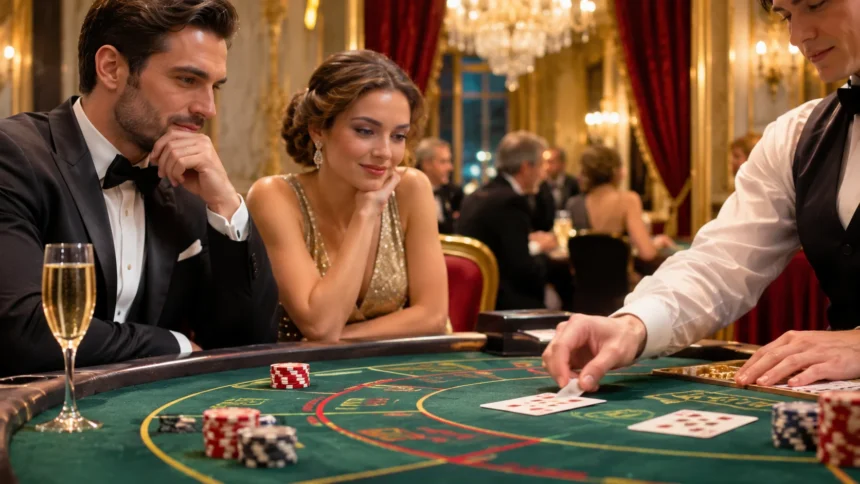
Baccarat is one of the most recognizable card games in casino history, known for its association with European aristocracy, elegant gaming rooms, and traditional card-playing culture. Although many people recognize its name, fewer understand how the game developed or why its origins remain mysterious. Its history connects European social traditions, mathematical research, popular entertainment, and changes in the international casino industry.
The story of baccarat is more complicated than the familiar claim that it was invented in fifteenth-century Italy. Historical records suggest that several popular origin stories cannot be verified, while reliable written descriptions emerged much later. Understanding these differences reveals how legends sometimes become accepted as facts when historical evidence is incomplete.
Exploring baccarat history offers an interesting perspective on the development of card games and their place in society. This article examines five lesser-known facts about baccarat, including its uncertain origins, relationship with French aristocracy, changing variations, famous historical controversies, and influence on mathematical research. It also explains how the game’s reputation evolved across different cultures.
What Is Baccarat and Why Is Its History Interesting?
Baccarat is a comparing card game traditionally associated with casinos and private gaming gatherings. Its basic identity centers on two designated hands, commonly described as the player and banker hands. Although modern audiences often encounter standardized versions, historical forms included different arrangements, social customs, and opportunities for decisions by participants.
The game’s reputation developed through connections with fashionable European society during the nineteenth century. Baccarat appeared in private clubs, wealthy households, and fashionable social circles where card games formed part of entertainment culture. Its association with expensive surroundings helped create an image of exclusivity that continued through literature, film, and casino advertising.
Studying baccarat provides more than a record of one card game’s development. Its history reflects changing attitudes toward gambling, differences between public and private entertainment, and the increasing standardization of commercial games. It also demonstrates how historians use documents, cultural references, and mathematical analysis to separate established facts from popular legends.
Fact 1: Baccarat’s Famous Italian Origin Story Is Unproven
One of the most repeated claims about baccarat history is that the game originated in Italy during the fifteenth century. Some accounts even attribute its invention to a particular Italian gambler or describe connections with medieval rituals. However, these stories lack reliable contemporary documentation confirming that baccarat existed in its recognizable form during that period.
The earliest known written references describing baccarat as a recognizable card game come from nineteenth-century France. This creates a substantial historical gap between the popular Italian origin story and the surviving evidence. Although it remains possible that earlier games influenced baccarat, researchers cannot confidently identify a specific inventor, location, or invention date.
This uncertainty makes baccarat different from games whose development can be traced through detailed historical records. Over time, repeated stories about Italian origins became familiar features of popular casino history. A more careful interpretation distinguishes cultural tradition from documented evidence, acknowledging that the game’s earliest development remains an unresolved historical question.
Fact 2: Baccarat Was Associated With French High Society
During the nineteenth century, baccarat became closely associated with fashionable social circles in France. Wealthy individuals participated in private gatherings where card games served as both entertainment and social activities. These settings helped establish baccarat’s reputation as a sophisticated pastime connected with aristocratic lifestyles and exclusive social environments.
The atmosphere surrounding historical baccarat differed considerably from modern commercial entertainment. Private salons and social gatherings emphasized personal connections, reputation, and established customs. Participation could also involve financial risks, making attitudes toward the game complicated even among people who considered card-playing a normal part of fashionable society.
French cultural influence played an important role in spreading baccarat’s reputation beyond its original social circles. References in historical writing and later popular entertainment reinforced its connection with elegant surroundings. However, this luxurious image represents only one part of the game’s history and does not eliminate the financial and social problems associated with gambling.
Fact 3: Baccarat Originally Had Several Different Forms
Many people assume that baccarat has always existed as one standardized card game. In reality, its historical development involved several related forms with different structures and traditions. Baccarat Banque, Chemin de Fer, and Punto Banco became important names associated with the game’s evolution, although their popularity varied between regions and historical periods.
Baccarat Banque is generally regarded as an older documented form, while Chemin de Fer developed into a recognizable variation during the nineteenth century. The French name Chemin de Fer translates to railway, although the precise explanation for its association with baccarat is debated. These variations reflected differences in how card games were organized in private and commercial settings.
Punto Banco emerged later and became especially influential in the modern casino industry. Its more standardized structure reduced the number of individual decisions traditionally associated with some earlier forms. This transformation illustrates how commercial entertainment industries often simplify and standardize older games to support consistent operations across different locations.
Fact 4: A Baccarat Scandal Reached the British Royal Family
One of the most remarkable episodes in baccarat history occurred in Britain during 1891. The Royal Baccarat Scandal involved allegations of cheating during a private card gathering attended by the Prince of Wales, who later became King Edward VII. The controversy attracted widespread public attention because of the participants’ social standing and royal connections.
The allegations centered on Sir William Gordon-Cumming, a British army officer accused of improper conduct during the game. He denied the accusation and pursued a legal action after the dispute became public. The trial generated significant newspaper coverage and raised questions about reputation, social privilege, and the behavior expected of prominent individuals.
The case became an important example of how a private social controversy could develop into a national public spectacle. It also highlighted tensions surrounding gambling in British society at the time. Baccarat’s connection with the royal household made the incident particularly memorable, ensuring its place in discussions of Victorian social history.
Fact 5: Baccarat Contributed to Mathematical Game Theory
Baccarat has an unexpected connection with mathematics and the study of decision-making. Certain historical forms contain situations involving competing decisions, probabilities, and different possible outcomes. These characteristics attracted researchers interested in understanding how rational choices operate when multiple participants have conflicting objectives.
Mathematicians have examined baccarat variations using concepts from probability theory and game theory. Chemin de Fer and Baccarat Banque are especially interesting because their decision structures differ from the more standardized Punto Banco format. Academic research has used these distinctions to explore mathematical models, strategic interaction, and the behavior of games involving uncertainty.
This mathematical connection demonstrates that traditional card games can serve as subjects for serious scientific analysis. Researchers study their structure to understand broader principles of decision-making rather than simply their entertainment value. Baccarat therefore occupies an unusual position in both cultural history and the academic study of mathematical games.
The Meaning Behind the Name Baccarat
The origin of the word baccarat is less certain than many popular explanations suggest. A frequently repeated story connects the name with an Italian word meaning zero. This explanation is often associated with the scoring terminology of the game, but historical linguists have not established it as a definitive origin.
French-language sources used the spelling baccara during the nineteenth century, while the spelling baccarat also became common. Historical dictionaries recognize uncertainty surrounding the word’s etymology. This means that descriptions presenting a single proven linguistic origin may simplify a more complicated and unresolved development.
The word baccarat also appears in other contexts, including the name of a French town associated with crystal production. However, sharing a name does not prove that the card game originated there. Distinguishing between similar words, locations, and traditions is an important part of understanding the game’s history accurately.
How Baccarat Spread Beyond France
Baccarat gradually became known outside France through social connections, travel, and the circulation of cultural traditions. Wealthy travelers and fashionable gatherings helped spread familiarity with European card games. As different societies encountered baccarat, local entertainment practices influenced how its variations were understood and presented.
The game’s movement into other countries was not necessarily a single event with one clear starting date. Historical adoption occurred through different social and commercial environments, and available records do not document every stage equally. This makes it difficult to construct a simple timeline showing exactly when baccarat became established in each region.
During the twentieth century, commercial casino development helped introduce standardized baccarat variations to broader international audiences. Changes in transportation, tourism, and entertainment businesses also influenced the game’s visibility. Its international expansion illustrates how a traditional European pastime became part of a larger global entertainment industry.
Baccarat’s Role in European Entertainment History
European card-playing traditions have existed for centuries and served many different social purposes. Games could provide recreation, competition, conversation, or opportunities for financial speculation. Baccarat developed within this wider culture, where the meaning of card-playing depended heavily on the setting and the people involved.
In fashionable nineteenth-century circles, card gatherings were sometimes connected with elaborate social customs and expectations. Wealth, personal reputation, and class distinctions influenced who participated in particular private events. These gatherings reveal how entertainment activities could reinforce social relationships while also creating disagreements, rivalry, and public controversy.
Public attitudes toward gambling changed across different countries and historical periods. Some communities tolerated private card games while restricting commercial gambling, and others introduced stricter legal controls. Baccarat’s changing reputation therefore reflects broader debates about leisure, social status, financial risk, and government regulation rather than a simple story of growing popularity.
How Baccarat Appeared in Literature and Popular Culture
Baccarat’s association with European high society made it an attractive subject for writers and entertainers. Literary references helped present the game as part of a world involving wealth, fashionable gatherings, and personal rivalry. These portrayals often emphasized the surrounding atmosphere rather than the detailed historical development of the game.
The game also became connected with fictional spy stories, particularly through the James Bond franchise. In Ian Fleming’s novel Casino Royale, the baccarat variation Chemin de Fer plays an important role in the narrative. This literary association helped reinforce baccarat’s image as a sophisticated activity linked with suspense and international intrigue.
Popular culture does not always provide an accurate description of historical practices. Films and novels frequently emphasize dramatic situations, glamorous settings, and exceptional characters rather than ordinary experiences. Nevertheless, these portrayals remain important because they influence how audiences remember baccarat and understand its place in entertainment history.
How Modern Baccarat Differs From Historical Baccarat
Modern baccarat is strongly associated with the standardized Punto Banco variation, particularly in large commercial casinos. Earlier historical forms often involved different organizational arrangements and participant roles. This distinction helps explain why descriptions of nineteenth-century baccarat do not always match modern representations of the game.
Commercial standardization changed more than the structure of baccarat itself. Modern casino environments introduced formal operating procedures, regulatory requirements, and consistent systems for managing activities. These developments reflected the growth of regulated gambling industries and the increasing importance of predictable business operations.
Despite these changes, baccarat retained several recognizable features that connect modern versions with their historical predecessors. Its name, distinctive terminology, and cultural reputation continue to reflect older traditions. Examining these similarities and differences provides useful evidence of how games evolve when they move between private social settings and commercial entertainment environments.
Why Baccarat Became Important in Asian Casino Markets
Baccarat became a major component of casino entertainment in several Asian markets, particularly Macau. Its prominence reflects the development of regional tourism, regulated gaming industries, and consumer entertainment preferences. However, its commercial importance should not be confused with evidence that every visitor participates in gambling or shares the same interests.
Macau’s historical position as a destination with a regulated casino industry helped shape baccarat’s modern international visibility. Industry reports and economic studies have frequently examined its contribution to local gaming revenue. These developments represent a considerably different environment from the private European social gatherings associated with baccarat during the nineteenth century.
The game’s presence in Asian markets also demonstrates how cultural products can change meaning when introduced into new economic environments. An activity once strongly associated with European aristocracy became linked with international tourism and large commercial entertainment businesses. Understanding this transformation provides a broader perspective on globalization and the changing economics of leisure.
Myths and Misconceptions About Baccarat History
The belief that baccarat was definitely invented in fifteenth-century Italy is among its most persistent historical misconceptions. Although the story appears frequently in popular descriptions, reliable contemporary evidence remains missing. Treating an uncertain tradition as an established fact can make the game’s history seem more precisely documented than it actually is.
Another misconception is that all versions of baccarat have always followed identical structures. Historical records and mathematical research demonstrate meaningful differences between Baccarat Banque, Chemin de Fer, and Punto Banco. These variations developed in different contexts, showing that baccarat’s present-day identity emerged through a process of historical change.
Some accounts also describe baccarat as an exclusively aristocratic activity throughout its entire history. While elite social circles played an important role in its early documented reputation, later commercial developments reached very different audiences. Separating myths from evidence helps produce a more balanced understanding of baccarat’s cultural, social, and economic significance.
What Baccarat History Reveals About Changing Society
The history of baccarat provides an interesting example of how entertainment can reflect broader social developments. Its association with nineteenth-century French aristocracy illustrates the relationship between leisure activities and social status. Later international expansion demonstrates how commercial institutions can transform activities that were once connected with relatively exclusive environments.
The Royal Baccarat Scandal also reveals the influence of public expectations on prominent historical figures. A dispute arising from a private gathering became a widely discussed controversy involving reputation, legal proceedings, and royal connections. Such events show that entertainment history can provide valuable information about social values and public attitudes.
Finally, baccarat’s mathematical and commercial development highlights the relationship between culture, research, and economics. A traditional card game became both a subject of academic analysis and a recognizable part of international casino history. These connections make baccarat useful for studying the evolution of popular entertainment without overlooking the social and financial risks associated with gambling.
Conclusion
Baccarat history contains more uncertainty and variety than many familiar origin stories suggest. Although legends describe its invention in fifteenth-century Italy, reliable written evidence places recognizable forms of the game in nineteenth-century France. Its connections with French aristocracy, changing variations, and the British royal scandal provide fascinating insights into European social history.
The game’s development also extended beyond traditional entertainment. Mathematical researchers studied its different forms, while literature and popular culture helped shape its public image. Later commercial expansion introduced baccarat to new international markets and transformed how it was presented within modern casino environments.
Understanding baccarat’s past requires distinguishing documented events from repeated legends and cultural assumptions. The five lesser-known facts explored in this article demonstrate how one card game connects historical research, social customs, mathematics, and international entertainment. Its story is ultimately about changing societies as much as the development of the game itself.
Frequently Asked Questions
Where did baccarat originally come from?
Baccarat is commonly linked to fifteenth-century Italy, but this origin has not been conclusively documented. The earliest reliable descriptions of recognizable baccarat appear in nineteenth-century France, leaving its exact beginnings uncertain.
How old is the game of baccarat?
Recognizable baccarat is documented in the nineteenth century, although some traditional accounts claim it existed much earlier. Historians cannot confidently establish an exact invention date because reliable earlier records are lacking.
Why was baccarat associated with royalty?
Baccarat gained an aristocratic reputation through its popularity in fashionable European social circles. Its association with royalty became especially prominent after the 1891 Royal Baccarat Scandal involving the future King Edward VII.
What are the historical variations of baccarat?
Three important variations are Baccarat Banque, Chemin de Fer, and Punto Banco. They developed different structures and traditions, reflecting the game’s evolution from European social gatherings to more standardized commercial environments.
Is baccarat mentioned in James Bond stories?
Yes, baccarat appears in Ian Fleming’s James Bond novel Casino Royale. The association with fictional espionage and elegant surroundings helped strengthen the game’s glamorous reputation in twentieth-century popular culture.