


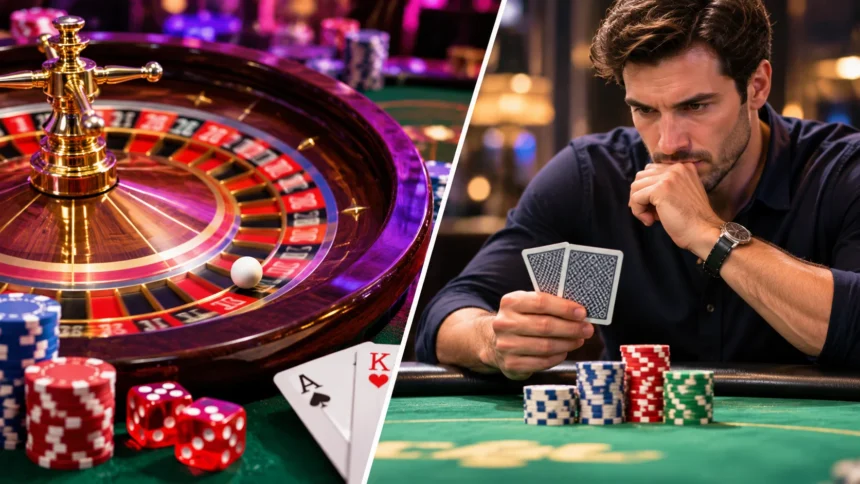
Casino games are often divided into two broad categories: games of chance and games involving skill. Although both types may involve uncertainty, they differ in how outcomes are determined and how much influence a player’s decisions can have. Understanding these differences is useful when studying probability, game design, mathematics, and the role of decision-making in different forms of entertainment.
Some casino games depend almost entirely on random events, while others include strategic choices that can influence results. However, even games involving skill usually contain an element of chance, and skill does not guarantee success. This guide explains casino games of chance vs skill, their mathematical differences, common examples, and the misconceptions surrounding game outcomes.
What Are Casino Games of Chance?
Casino games of chance are games in which outcomes depend primarily on random events rather than the abilities of individual participants. Results may be determined by shuffled cards, dice, spinning wheels, or computer-generated random numbers. The defining characteristic is that players have little or no meaningful control over the random outcome itself.
In traditional chance-based games, the rules establish possible outcomes and the mathematical probability associated with each event. For example, rolling a fair six-sided die produces six possible results with equal individual probabilities. Real casino games may involve more complicated rules, but randomness remains central to their design.
These games illustrate important mathematical concepts, including probability distributions, independent events, and expected value. A player may choose when to participate, but that decision does not necessarily change the underlying probability of a particular random result. Understanding this distinction is important when comparing chance-based activities with games involving meaningful strategic decisions.
What Are Skill-Based Casino Games?
Skill-based casino games involve decisions that can influence results within the rules of the game. Players may need to evaluate information, compare possible actions, or make choices based on changing circumstances. These decisions introduce a skill component, although random events may still affect the final outcome.
Poker is a familiar example of a game that combines skill and chance. The distribution of cards involves randomness, while decisions and interpretations of available information influence how a hand develops. This combination makes poker different from games in which participants have almost no control after a random event begins.
Skill-based elements can also appear in certain card games and specialized gaming formats. However, the presence of decision-making does not mean that every participant can consistently achieve favorable outcomes. Rules, uncertainty, competition, and mathematical conditions remain important factors in determining results.
Casino Games of Chance vs Skill: Main Differences
The central difference between chance and skill lies in how much player decisions influence the outcome. In a chance-dominated game, results are largely determined by random mechanisms. In a skill-influenced game, decisions can meaningfully affect results, even when uncertainty remains part of the experience.
Chance-based games generally emphasize probability and random variation, while skill-influenced games introduce additional considerations such as information, judgment, and decision quality. This does not create a simple division between games that are completely random and games that are completely controllable. Many games contain elements of both categories.
Another difference involves how results should be interpreted. In random games, a positive outcome does not demonstrate superior ability. In skill-influenced games, a single result may still provide little evidence of a participant’s competence because luck can have a substantial effect over short periods.
How Probability Works in Games of Chance
Probability describes how likely an event is to occur under defined conditions. It is commonly expressed as a fraction, percentage, or number between zero and one. Understanding probability helps explain why certain outcomes occur more frequently than others over large numbers of observations.
A fair coin provides a simple example of independent random events. Each flip has an equal probability of landing on either side, assuming the coin and flipping process are fair. The result of one flip does not cause the next flip to become more likely to produce the opposite outcome.
Casino games may use more complicated random processes than coins or dice, but the same mathematical principles apply. Probability can describe the structure of a game without predicting the next individual result. This distinction helps explain why random sequences sometimes appear unusual even when the underlying process is functioning normally.
What Is the Role of Luck in Casino Games?
Luck refers to the influence of events that participants cannot reliably control or predict. In casino games, random outcomes may produce favorable or unfavorable results regardless of an individual’s expectations. This uncertainty is a defining feature of chance-based gaming activities.
Luck also affects games that contain meaningful elements of skill. A participant may make a reasonable decision and still experience an unfavorable outcome because important information or events remain uncertain. Similarly, a poor decision can occasionally produce a favorable result without becoming a sound choice.
Recognizing the role of luck helps prevent incorrect conclusions about personal ability. A sequence of positive outcomes does not necessarily establish that someone can control randomness. Studying game results requires distinguishing between decisions, probabilities, and unpredictable events rather than treating every outcome as evidence of skill.
Slot Machines as an Example of Chance-Based Games
Slot machines are commonly classified as games of chance because their outcomes are determined through random mechanisms. Modern electronic machines generally use random number generators to select results according to programmed game rules. The visible symbols and animations represent the outcome rather than allowing the player to control it.
The appearance of a near miss or repeated symbol does not mean that a particular result is becoming due. Random number generation is designed to produce outcomes according to the game’s mathematical structure. Previous spins generally do not determine the result of the next independent spin.
Slot machines provide a useful example of how visual presentation can influence people’s interpretation of randomness. Bright graphics, sound effects, and animated sequences can make ordinary probability events feel more meaningful. Understanding these design features helps distinguish the entertainment presentation from the underlying mathematical process.
Roulette and the Mathematics of Random Outcomes
Roulette is another well-known example of a casino game dominated by chance. A ball moves around a spinning wheel before coming to rest in one of the numbered pockets. The result depends on physical conditions and wheel movement rather than a participant’s ability to determine the final pocket.
Different roulette wheel designs contain different numbers of pockets, affecting their mathematical probabilities. European roulette traditionally includes a single zero, while American roulette commonly includes both zero and double zero. These structural differences influence the underlying expected return established by the game rules.
Roulette also illustrates why independent outcomes are frequently misunderstood. A sequence of similar results does not establish that the opposite outcome must occur next. This mistaken belief is known as the gambler’s fallacy and appears in many situations involving random events.
How Dice Games Demonstrate Pure Chance
Dice games provide straightforward examples of random outcomes because their results depend on how physical dice land. With a fair six-sided die, each numbered face has an equal probability of appearing. The outcome is not determined by a player’s hopes, previous results, or interpretation of patterns.
Games involving several dice may create more complicated probability distributions. For example, some totals can occur through more combinations than others. This means not every possible sum has the same probability, even when each individual die is fair.
Understanding dice probabilities is useful beyond casino games because the same mathematical principles appear in statistics and scientific experiments. Dice illustrate the difference between equally likely individual outcomes and combined events with varying probabilities. They also demonstrate why repeated random results can create patterns without any hidden controlling force.
Why Poker Combines Skill and Chance
Poker combines randomly distributed cards with decisions that can influence the development of a game. Participants operate with incomplete information and must interpret available evidence. This makes poker different from activities where players have almost no meaningful influence over the result after the random mechanism begins.
The random distribution of cards can strongly influence individual hands. As a result, one successful outcome does not establish that a participant made better decisions than someone else. Evaluating skill requires considering decision quality across many situations rather than focusing on one isolated result.
Poker also shows how competition changes the relationship between skill and chance. Participants make choices while responding to other people’s actions, creating additional uncertainty. However, recognizing that skill exists does not mean financial outcomes are predictable or that participation provides a reliable source of income.
Is Blackjack a Game of Chance or Skill?
Blackjack contains both chance and decision-making elements. The cards are distributed through a random process, while players may face choices within the rules of the game. These decisions can affect the mathematical outcomes of particular situations, making blackjack different from games based entirely on random events.
However, decision-making does not remove uncertainty from blackjack. Players cannot reliably determine which cards will appear next, and unfavorable results remain possible even when choices are logically consistent. The game’s rules and mathematical structure also influence long-term expected outcomes.
Blackjack is therefore commonly described as a mixed game involving both luck and skill. The exact balance depends on how skill is defined and which version of the game is being examined. It is inaccurate to describe blackjack as either completely controllable or entirely free of decision-making.
Understanding the House Edge in Casino Games
The house edge is a mathematical concept describing the expected percentage of wagers retained by a casino over a large number of repeated plays. It reflects the rules and payout structure of a particular game. The house edge does not predict what will happen during one individual session.
For example, a game with a positive house edge for the operator has a built-in mathematical advantage under its stated conditions. Individual outcomes may vary considerably, sometimes producing short sequences that appear inconsistent with long-term averages. These variations do not change the underlying expected value of the game.
The house edge is important when comparing chance-based games with skill-influenced activities. Player decisions may affect expected outcomes in certain games, but they do not automatically eliminate an operator’s mathematical advantage. Understanding expected value helps separate long-term probability from unpredictable short-term results.
What Is Expected Value in Gambling Mathematics?
Expected value represents the mathematical average outcome of an uncertain process over repeated observations. It is calculated by considering possible results and their respective probabilities. In casino mathematics, expected value helps describe the underlying structure of games rather than guaranteeing any specific individual outcome.
A negative expected value means the mathematical average favors a loss for the participant under the defined conditions. However, short-term results can differ substantially from this average because of randomness. This is why observing a few outcomes does not provide a dependable picture of long-term mathematical expectations.
Expected value also appears outside gambling in fields such as insurance, economics, and risk analysis. It helps researchers compare uncertain situations using consistent mathematical principles. Learning the concept provides a useful foundation for understanding probability without relying on personal beliefs about luck or winning streaks.
Random Number Generators in Online Casino Games
Random number generators, commonly called RNGs, are systems that produce sequences used to determine digital game outcomes. Many online casino games rely on these technologies rather than physical dice, cards, or spinning wheels. Their purpose is to generate results according to the game’s programmed mathematical structure.
Different systems may use software-based pseudorandom number generation or other sources of randomness. Proper implementation and testing are important because flaws can affect the integrity of results. Independent evaluation and regulatory oversight may apply in jurisdictions that permit and regulate online gambling services.
A random number generator does not necessarily make every possible result equally likely. The game’s rules can assign different probabilities to different outcomes. Understanding this distinction is important because fairness, randomness, and equal probability are related concepts but do not mean exactly the same thing.
Can Skill Overcome Luck in Casino Games?
Skill can influence decision quality in certain games, but its effect depends on the structure of the activity. In games dominated by random outcomes, personal ability may have little influence on the result. In other games, decisions can meaningfully affect what happens within the rules.
However, the presence of skill does not guarantee a positive outcome. Random variation can produce unexpected results, while competition and incomplete information introduce additional uncertainty. Even experienced participants cannot eliminate all unpredictable factors from games involving chance.
It is also important to distinguish improved decision-making from guaranteed financial success. A person may understand a game’s mathematical structure without controlling its outcomes. Skill should therefore be evaluated carefully rather than used as evidence that gambling results can be made certain.
Common Myths About Games of Chance and Skill
One common myth is that repeated losses make a favorable random outcome more likely. This belief confuses independent events with processes that have memory. In games where each event is independent, previous results do not create a requirement for future outcomes to balance immediately.
Another misconception is that participants can reliably detect hidden patterns in random sequences. Humans naturally search for meaningful relationships, even when events occur by chance. Apparent streaks and unusual combinations can emerge without deliberate manipulation or any predictable underlying pattern.
Some people also assume that games involving skill are automatically safer or more financially predictable than games of chance. This is not necessarily true because skill-based decisions can still involve substantial uncertainty. Understanding the rules and mathematics of a game is different from controlling or guaranteeing its results.
How Game Design Influences Player Decisions
Casino games use visual presentation, sound, pacing, and reward feedback to create an engaging experience. These features can affect how participants interpret outcomes and perceive progress. The design of a game may make certain events feel significant even when they do not change the underlying probabilities.
Near-miss effects are one example of how presentation can influence perception. An outcome that appears close to a favorable result may feel different from an ordinary loss. However, visual closeness does not necessarily provide information about the probability of a future outcome.
Understanding game design is useful for studying psychology and decision-making. Researchers examine how feedback, uncertainty, and repeated rewards influence behavior. This knowledge also supports consumer awareness by helping people recognize the difference between emotional reactions and mathematical evidence.
Are Casino Games Entirely Random?
Not every casino game is entirely random, although chance plays an important role in many familiar examples. Slot machines and roulette are strongly determined by random outcomes. Poker and blackjack include additional decisions that can influence results, creating a combination of skill and uncertainty.
The distinction depends on how the game’s rules are structured. A participant may be able to choose an action without meaningfully changing the random mechanism. In other activities, decisions can affect which outcomes remain possible or how a game develops.
For this reason, classifying games requires more than asking whether participants make choices. The important question is whether those choices meaningfully influence results under the rules. Understanding this distinction produces a clearer comparison between games of chance and games involving skill.
Why Understanding Chance vs Skill Matters
Understanding the difference between chance and skill supports more accurate thinking about probability and decision-making. It helps explain why some outcomes cannot be controlled through experience or personal judgment. This distinction is especially useful when evaluating claims about predictable results or guaranteed success.
The subject also connects to broader concepts in statistics, economics, and behavioral psychology. Random variation can influence outcomes in many real-world situations, including scientific experiments and financial decisions. Learning to recognize uncertainty helps people avoid drawing strong conclusions from limited information.
A balanced understanding also highlights the importance of consumer protection and informed decision-making. Gambling activities may involve financial risks regardless of whether skill affects certain choices. Recognizing these risks and the limits of personal control is an essential part of understanding casino game mechanics.
Conclusion
Casino games of chance vs skill differ mainly in how much influence participant decisions have over outcomes. Games such as slots and roulette depend heavily on randomness, while poker and blackjack include meaningful decision-making elements. However, chance remains important even when skill affects how a game develops.
Mathematical concepts such as probability, expected value, and the house edge help explain the structure of casino games. They also show why short-term outcomes can differ considerably from long-term averages. Understanding these principles helps separate genuine decision-making from misconceptions about patterns, streaks, and predictable results.
Neither chance-based nor skill-influenced games provide guaranteed outcomes. Learning how their rules operate is valuable for understanding uncertainty, game design, and risk. A realistic view of casino mathematics recognizes both the role of randomness and the limits of human control over unpredictable events.
Frequently Asked Questions
What is the main difference between games of chance and skill?
Games of chance depend primarily on random outcomes, while skill-based games allow participant decisions to influence results. Many casino games combine both elements, although the balance varies.
Is poker a game of chance or skill?
Poker involves both chance and skill. Cards are distributed randomly, while decisions influence how hands develop. However, individual outcomes remain uncertain even when participants make carefully considered choices.
Are slot machines games of pure chance?
Slot machines are predominantly games of chance because outcomes are determined through random mechanisms. Player actions generally do not control the result of an individual spin or make future random outcomes predictable.
Does skill guarantee winning in casino games?
No, skill does not guarantee favorable outcomes. Randomness, competition, and game rules can affect results, meaning even games with meaningful decision-making elements remain uncertain.
What does house edge mean in casino games?
The house edge describes the casino’s mathematical advantage over many repeated plays under specific rules. It does not predict individual outcomes or guarantee that every session will produce the same result.