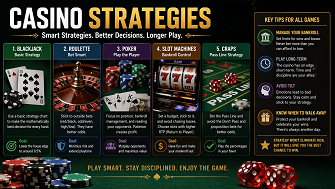



Casino games involve chance, probability, and mathematical systems that determine how frequently different outcomes may occur. Although gambling is often presented as entertainment, understanding its underlying mathematics is important for recognizing financial risks and avoiding misleading expectations. Learning about casino odds helps explain why some outcomes are more likely than others and why gambling operators generally maintain a mathematical advantage.
Different casino games use different probability structures. Slot machines rely on programmed random outcomes, while card games, dice games, and roulette use mathematical probabilities associated with their rules. Despite these differences, the important principle remains the same: random outcomes cannot be reliably predicted, and previous results do not guarantee what will happen next.
Understanding casino mathematics does not make gambling risk-free or provide a dependable way to earn money. Instead, it can help people recognize common misconceptions about winning, losing, and financial returns. This guide explains casino odds, probability, house edge, expected value, and the psychological factors that can influence how people interpret gambling outcomes.
What Are Casino Odds?
Casino odds describe the mathematical likelihood of particular outcomes occurring in games of chance. They are based on the possible results allowed by a game’s rules or random-number system. Understanding these probabilities helps explain why some events occur frequently while others are relatively uncommon.
Odds and probability are closely related, but they are not always expressed in the same format. Probability describes the proportion of possible outcomes associated with an event, while odds compare favorable and unfavorable possibilities. Both concepts can be used to explain uncertainty, although their meaning depends on how the information is presented.
Casino odds do not represent a promise that a particular result will occur within a specific number of attempts. Even when an outcome has a known mathematical probability, individual results remain uncertain. This distinction is important because misunderstandings about probability can lead people to develop unrealistic expectations about gambling.
How Probability Works in Casino Games
Probability is a mathematical measurement of how likely an event is to occur. It is commonly expressed as a number between zero and one or as a percentage between zero and one hundred. An impossible event has a probability of zero, while a certain event has a probability of one hundred percent.
For example, a fair coin has two equally likely outcomes, giving each side a probability of fifty percent. However, this does not mean that ten flips must produce exactly five of each result. Random variation can produce uneven sequences, particularly when the number of observations is relatively small.
Casino games involve more complicated probability structures, but the same mathematical principles apply. Some games have many possible outcomes, while others involve combinations of events. Understanding probability provides a foundation for recognizing uncertainty without assuming that mathematical knowledge can eliminate the possibility of financial loss.
What Is the House Edge in Casino Games?
The house edge is a mathematical measure of the casino’s expected advantage over the money wagered in a particular game. It is usually expressed as a percentage. This advantage helps explain why gambling businesses can generate revenue over large numbers of transactions even though individual participants may occasionally receive payouts.
For example, a theoretical house edge of five percent means the operator expects to retain an average of five units for every one hundred units wagered over a sufficiently large volume of play. It does not mean that every participant loses exactly five percent. Individual outcomes may differ substantially from the mathematical expectation.
The house edge reflects the structure of the game rather than a guarantee about any single result. Actual performance can vary over short periods because random events produce unpredictable sequences. Over many repeated transactions, however, average outcomes tend to move closer to their underlying mathematical expectations under stable game conditions.
Understanding Expected Value in Gambling
Expected value is a mathematical concept used to describe the average result of a random process over many repetitions. It combines the probability of possible outcomes with the value associated with each result. In gambling, expected value helps explain the difference between occasional individual payouts and the overall financial structure of a game.
A negative expected value means that the mathematical average favors losing money rather than gaining it over repeated participation. Many commercial casino games are structured around this principle. Although some participants may experience positive short-term results, those outcomes do not change the underlying mathematical expectation.
Expected value is useful for understanding financial risk, but it cannot predict what will happen to a particular person during an individual session. Random variation can produce outcomes above or below the calculated average. Recognizing this limitation helps prevent the mistaken belief that a favorable short-term result proves that future profits are likely.
How Random Number Generators Work
Many electronic casino games use random number generators, commonly called RNGs, to determine outcomes. These systems produce sequences of numbers that are processed according to a game’s programmed rules. Properly designed and tested random-number systems are intended to prevent players from reliably predicting future results.
Electronic gaming outcomes are not normally determined by whether someone has recently experienced a win or a loss. In systems where each event is independent, earlier results do not change the probability of the next outcome. This principle helps explain why observing previous patterns cannot establish what will happen next.
Regulated gaming systems may undergo independent testing to evaluate whether their randomization mechanisms operate according to applicable requirements. However, technical approval does not mean the games provide favorable financial expectations for participants. Randomness supports unpredictable outcomes, while payout structures and game rules determine the operator’s mathematical advantage.
Why Previous Results Do Not Predict Future Outcomes
One of the most common misunderstandings about gambling is the belief that previous results influence independent future events. This reasoning is known as the gambler’s fallacy. It occurs when someone assumes that an outcome becomes more likely simply because it has not appeared recently.
Consider a fair coin that lands on heads several times in succession. The next flip still has a fifty percent probability of landing on heads if each flip is independent. The earlier results do not create a mathematical obligation for tails to appear or restore an imagined balance.
The same principle applies to independent outcomes in many casino games. A sequence of losses does not establish that a win is approaching, just as a series of wins does not guarantee continued success. Understanding independence helps people avoid interpreting random patterns as reliable signals about future events.
Casino Odds vs. Payout Percentages
Casino odds and payout percentages describe related but different aspects of gambling mathematics. Odds focus on the likelihood of outcomes, while payout percentages describe how much money a game is mathematically expected to return relative to the amount wagered. Both concepts influence the overall financial structure of casino games.
Return to player, commonly abbreviated as RTP, is a theoretical percentage associated with certain gambling products. For example, a theoretical RTP of ninety-five percent indicates an expected return of ninety-five units for every one hundred units wagered across a sufficiently large volume of play. This is not a guarantee for an individual participant.
Payout percentages can be misunderstood because they appear to suggest predictable refunds or rewards. In reality, short-term outcomes may be dramatically different from theoretical averages. The percentage describes a long-run mathematical property rather than a promise that a person will recover a specific portion of their spending.
Understanding Variance and Volatility
Variance describes how widely possible outcomes differ from their average or expected value. In gambling, games with greater variance may produce larger fluctuations in results. A mathematical average alone does not reveal how unpredictable individual outcomes can be, making variance an important part of understanding financial uncertainty.
Volatility is another term frequently used when describing differences in gambling outcomes. High-volatility systems are generally associated with less frequent but potentially larger variations in results. Lower-volatility systems may produce different patterns, although neither category removes the underlying risk of financial loss.
Variance and volatility should not be confused with the likelihood of generating a profit. A game can have different levels of outcome variability while still maintaining a negative expected value for participants. Recognizing these distinctions helps explain why short periods of favorable results do not necessarily reflect the underlying financial structure.
Why Casinos Have a Mathematical Advantage
Commercial casino games are generally designed with payout structures that favor the operator over large numbers of transactions. The mathematical advantage may come from differences between the probability of winning and the amounts paid for successful outcomes. These features allow the business to generate expected revenue while individual results remain uncertain.
The operator’s advantage does not require every participant to lose during every session. Some people may receive substantial payouts, while others experience repeated losses. The overall business model depends on the combined mathematical results across many gambling transactions rather than predictable outcomes for particular individuals.
Understanding this structure helps explain why gambling should not be treated as a reliable source of income. Occasional positive outcomes can create an impression of opportunity, but they do not remove the expected disadvantage built into many games. Financial planning should therefore rely on dependable income and responsible money management rather than gambling outcomes.
The Difference Between Skill and Chance
Some games involve decisions that influence particular outcomes, while others rely almost entirely on chance. However, the presence of a skill-related element does not automatically make gambling financially favorable. Mathematical rules, payout structures, and uncertainty continue to affect the possible results.
Chance-based events are inherently unpredictable at the individual level. Even when probabilities are accurately calculated, there is no guarantee that a particular event will occur during a specific attempt. Skill-based decisions may influence some outcomes, but they do not eliminate the possibility of losing money.
This distinction is important because people sometimes overestimate how much control they have over uncertain events. Familiarity with a game can create confidence without changing its fundamental mathematical structure. Understanding the limitations of personal control helps encourage more realistic expectations about randomness and financial risk.
Common Myths About Casino Odds
A common myth is that a game must produce a favorable outcome after several unfavorable results. This belief incorrectly assumes that independent random events naturally correct previous sequences. Mathematical probability does not require short-term outcomes to follow an evenly balanced pattern.
Another misconception is that observing a game’s past results can reveal a reliable pattern for predicting future outcomes. Random sequences sometimes contain clusters or repetitions that appear meaningful. However, these patterns may occur naturally through chance and do not necessarily provide information about what will happen next.
Some people also believe that understanding casino mathematics guarantees an advantage over the operator. Mathematical knowledge can explain probability and risk, but it does not automatically change payout rules or remove uncertainty. Recognizing these misconceptions is valuable for avoiding unrealistic financial expectations.
Why Gambling Can Create Financial Stress
Gambling can create financial stress when spending begins affecting essential expenses, savings, or personal responsibilities. Because outcomes are uncertain, money used for gambling may not be recovered. Repeated losses can become particularly difficult when someone attempts to resolve financial concerns through further gambling.
Emotional reactions may also influence financial decisions. Frustration, excitement, and disappointment can make it harder to evaluate risks clearly. The desire to recover previous losses can increase financial pressure because additional participation introduces more uncertainty rather than providing a dependable solution.
Financial stress can affect relationships, work, education, and everyday well-being. When gambling begins causing repeated concerns, stepping away and discussing the situation with someone trustworthy can be helpful. Qualified financial counselors and mental health professionals can also provide support when gambling-related difficulties become challenging to manage.
Recognizing Misleading Gambling Claims
Advertisements and informal discussions sometimes present gambling as an easy way to earn money or achieve financial success. Such claims may emphasize unusual payouts while providing limited information about losses and mathematical expectations. This selective presentation can create misleading impressions about the likelihood of positive outcomes.
Another warning sign is language suggesting that a particular system can guarantee favorable results. Claims involving certain predictions, secret patterns, or unavoidable winning sequences should be treated with skepticism. Random outcomes and negative expected values cannot be eliminated simply through persuasive marketing or confident explanations.
Understanding probability makes it easier to question these claims and recognize their limitations. Reliable mathematical information should clearly distinguish theoretical averages from individual results. People should be cautious of messages that encourage gambling as a solution to financial difficulties or imply that losses can always be recovered.
When Gambling Stops Feeling Like Entertainment
Gambling may become harmful when it begins causing ongoing stress, financial concerns, or difficulty maintaining everyday responsibilities. Someone might notice that gambling occupies more of their thoughts or becomes connected with attempts to recover previous losses. These changes can occur gradually and deserve attention before problems become more serious.
Warning signs may include hiding spending, experiencing repeated conflicts, borrowing money because of losses, or struggling to stop. Emotional reactions such as anxiety, irritability, and guilt can also indicate that gambling is affecting well-being. Recognizing these patterns is important because financial consequences are not the only measure of harm.
Taking a break and speaking with a trusted person can provide an opportunity to reassess the situation. Professional counselors and gambling support services can offer additional assistance when gambling becomes difficult to manage. Seeking support early can help protect emotional health, relationships, and financial stability.
How to Learn Probability Without Gambling
Probability can be studied through everyday examples that do not involve financial risk. Coin flips, classroom experiments, dice-based mathematics demonstrations, and probability puzzles provide opportunities to understand uncertain outcomes. These activities illustrate important concepts without requiring participation in commercial gambling.
Educational simulations can also help demonstrate how theoretical probabilities compare with observed results. For example, a classroom exercise involving repeated coin flips can show how short sequences may vary from expected averages. Larger samples often provide results closer to the theoretical probability, although individual outcomes remain unpredictable.
Studying probability through mathematics, statistics, and educational examples provides broader benefits beyond understanding gambling. These skills can support critical thinking, financial literacy, and interpretation of uncertain information. Learning the underlying concepts independently of gambling creates opportunities to explore mathematics without exposure to avoidable financial risks.
Conclusion
Understanding casino odds provides useful insight into probability, random outcomes, house edge, and expected value. These concepts explain why gambling results are uncertain and why commercial casino games generally maintain a mathematical advantage. Individual outcomes may vary considerably, but occasional positive results do not change the underlying financial structure.
Probability also helps explain why common beliefs about winning streaks, previous losses, and predictable patterns can be misleading. Independent events do not remember earlier outcomes, and theoretical payout percentages do not guarantee individual returns. Recognizing these facts can support better financial awareness and more realistic expectations.
The most valuable reason to understand gambling mathematics is to recognize uncertainty and financial risk. Gambling should not be considered a dependable income strategy or a solution to financial problems. Studying probability through educational activities and seeking support when gambling causes harm can encourage healthier decisions and stronger financial understanding.
Frequently Asked Questions
What do casino odds mean?
Casino odds describe the mathematical likelihood of specific outcomes occurring in games of chance. They help explain uncertainty but do not guarantee that a particular result will happen during an individual event.
What is the house edge in gambling?
The house edge represents the operator’s expected mathematical advantage over the amount wagered. It describes long-run expectations rather than predicting how much any particular person will win or lose.
Can casino odds predict the next result?
No, probabilities describe how likely outcomes are, but they cannot reliably predict individual results in independent random events. Previous outcomes do not guarantee what will happen next.
What is the difference between RTP and house edge?
RTP describes the theoretical percentage returned over many transactions, while house edge represents the operator’s expected advantage. Both are long-run mathematical measures, not guarantees of individual financial outcomes.
Why do people misunderstand gambling probabilities?
People may interpret random patterns as meaningful or assume previous results influence future independent events. These misconceptions can create unrealistic expectations and encourage decisions based on misleading assumptions rather than mathematical probability.