

Ask a competitive gamer why they still bother with browser titles when consoles and high-end PCs exist, and you’ll usually get a shrug before the answer. It’s not nostalgia. It’s not a lack of options either. It’s that browser gaming still does something native platforms are surprisingly bad at: getting a player from curiosity to actual competition in under a minute.
That gap matters more than people give it credit for. A decade of smartphones, cloud infrastructure, and faster connections has made almost every form of digital entertainment more accessible. And yet browser gaming hasn’t just survived that shift, it’s leaned into it, building a loyal base of players who care less about polish and more about whether a game respects their time and rewards actual skill.
Speed Is Now a Competitive Edge, Not Just a Convenience
Modern internet users have gotten used to instant everything. Streaming killed physical media. Cloud storage made local files feel almost old-fashioned. Web apps quietly replaced software you used to have to install and babysit through updates. Gaming followed the same current, whether the industry planned it that way or not.
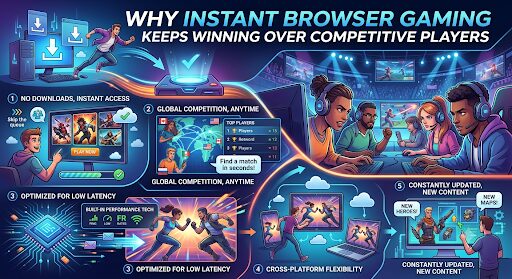
Browser-based titles slot right into this world because there’s essentially no gap between deciding to play and actually playing. Open a laptop at home, or pull out a phone between train stops, and you’re in. No patch downloading in the background. No storage warning popping up at the worst possible moment.
For players who treat their time as a limited resource, and competitive players tend to, that immediacy isn’t a nice extra. It’s often the deciding factor in which game gets their attention on any given evening.
What Competitive Players Actually Care About
Here’s something that gets overlooked constantly: flashy graphics rarely keep serious players around. They might get someone to click once. They don’t explain why someone’s still logging in six months later.
What does explain it, almost every time, is whether the game rewards getting better at it. Competitive environments built around practice, pattern recognition, and adapting to an opponent create a different kind of pull than anything cosmetic ever could. Progress in these games isn’t handed to you through a loot box. It’s earned through repetition, and that earns loyalty in return.
A fair number of browser games have built themselves entirely around this idea, and it shows. Players stick around because improvement is visible and personal, not because there’s a new skin to unlock. That’s a much harder thing to fake, and it’s part of why certain browser titles have held onto dedicated communities for years while flashier competitors came and went.
The Technology Quietly Stopped Being the Limiting Factor
If you tried a browser game ten years ago and wrote the format off, you’re judging it by a version that doesn’t really exist anymore. HTML5 matured. JavaScript got faster in ways most players never noticed happening. WebGL closed a visual gap that used to be embarrassingly wide.
What’s actually running in a browser now includes:
- High definition visuals that don’t look like a compromise
- Low latency gameplay, which matters enormously for anything competitive
- Cross-platform compatibility without separate builds for every device
- Cloud synchronization that keeps progress intact across sessions
- Real multiplayer infrastructure, not a watered down version of it
- Interfaces that actually work on a phone screen instead of just fitting on one
None of this arrived in a single dramatic update. It came from years of incremental browser improvements stacking on top of each other, mostly invisible to the average player, until one day the gap between browser and native just wasn’t worth arguing about anymore.
Devices Change Constantly, and the Games Have to Keep Up
Nobody sticks to one device anymore, and competitive players are arguably the worst offenders. A session might start on a laptop after dinner, continue on a tablet an hour later, and get checked briefly on a phone the next morning before work.
Browser platforms handle this shift without much friction because the experience isn’t tied to a specific operating system or app store to begin with. A well built browser game behaves consistently whether it’s rendered on a 27-inch monitor or a phone screen a fraction of that size, and that consistency is exactly what players expect now without even thinking about it.
There’s a real business logic behind this too. Maintaining one adaptable browser experience costs considerably less than juggling separate native apps for iOS, Android, and desktop, each with its own update cycle and its own bugs to chase. Smaller studios in particular have leaned into this efficiency, since it lets a lean team support an audience that would otherwise require a much larger one.
Community Is Doing More Work Than People Assume
Competitive gaming has never really existed in a vacuum, but the social layer around it has grown considerably. Forums, livestreams, and social clips have turned individual play sessions into something closer to an ongoing conversation.
This shift matters because communities don’t just support a game, they often keep it alive well past the point where a purely solo experience would have faded out. Players exchange strategies, argue about metas, and organize informal tournaments that no developer had to design or fund directly. That kind of grassroots engagement is difficult to manufacture and easy to underestimate.
Communities also do something developers can’t do alone: they introduce new players to older, established titles. A browser game that’s been around for years can still pick up fresh players simply because someone shared a clip or recommended it in a Discord server, which says a lot about how much staying power word of mouth still has in this space.
Low Commitment Encourages Genuine Exploration
There’s a reason browser gaming works so well as a discovery format. Trying something new usually costs nothing but a few minutes. No large download, no storage decision to weigh, no account creation gauntlet standing between curiosity and actually playing.
That low barrier does something useful for players and developers alike. Players get to sample genres they might never have downloaded on purpose, and developers get a much wider audience willing to give something unfamiliar a shot, simply because the cost of trying is close to zero.
Infrastructure Keeps Raising the Ceiling
Cloud computing and better networking have quietly expanded what’s technically possible in a browser. Features that used to be exclusive to native apps, persistent accounts, synchronized progress, real matchmaking systems, now show up regularly in browser environments without anyone treating it as remarkable.
Artificial intelligence is starting to factor in here too, shaping recommendations and balancing gameplay in ways that adjust to how someone actually plays over time. None of it requires new hardware or a complicated setup. It simply builds on infrastructure that was already there, which is part of why these upgrades tend to arrive so quietly.
Platforms Built Around Skill Keep Earning Loyalty
Competitive players gravitate toward platforms that reward consistency and genuine decision-making rather than just visual flash. Enthusiasts drawn to Tangkasnet tend to describe exactly this kind of appeal: the satisfaction of steady, earned improvement within a format that respects both accessibility and real competitive stakes.
That combination isn’t easy to pull off. Plenty of platforms lean too hard into accessibility and end up feeling shallow, while others chase competitive depth and lose the casual audience that keeps a community large enough to matter. The ones that manage both tend to be the ones still standing years later.
Fitting Into Lives That Don’t Have Much Spare Room
Most people juggling work, school, and everything in between don’t have hours to dedicate to installing software or committing to long sessions. Browser-based entertainment offers a practical middle ground, making solid gameplay available whenever a few free minutes actually show up.
Whether that’s five minutes during a break or a longer stretch in the evening, instant access lines up naturally with how people actually structure their days now, rather than asking them to rearrange their schedule around a game.
Where This Is Headed
Faster connections, better browser engines, and continued cloud investment all point toward the gap between browser and native software shrinking even further, not widening back out. Developers focused on accessibility have little reason to abandon a format that keeps delivering results.
Browser gaming isn’t trying to replace downloadable titles, and it probably never will. It’s carving out its own space instead, one built around speed, low commitment, and genuine competitive depth, and that space keeps proving more durable than early skeptics expected.
The Bottom Line
Instant browser gaming like bola tangkas online keeps appealing to competitive players because it manages to combine accessibility with real strategic substance, something a lot of formats promise but few actually deliver. As web technology keeps advancing in the background, browser platforms are only getting better at offering responsive, community-driven experiences without asking players to sacrifice much to get them.
For players who want quick access without giving up meaningful competition, browser gaming remains one of the more practical, and honestly underrated, corners of digital entertainment still standing today.