


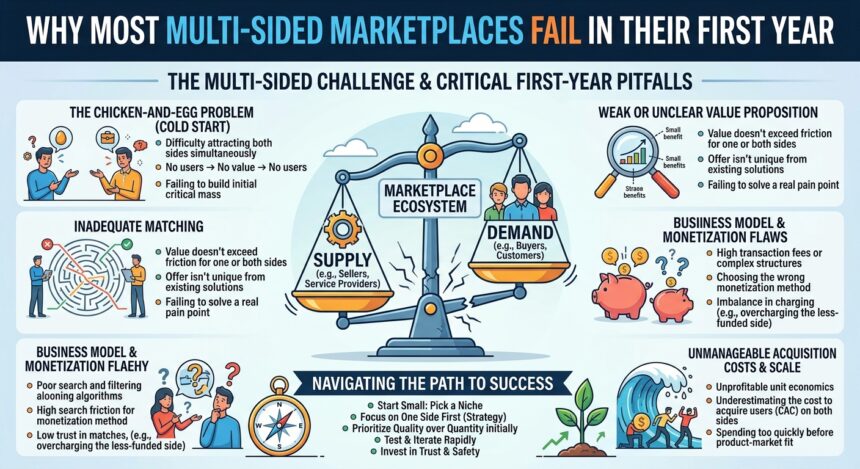
Marketplaces look deceptively simple from the outside. Buyers arrive, sellers list, the platform takes a cut. In practice, a multi-sided platform is one of the hardest business models to launch, because it asks a founder to build two or three products at once and to make each of them valuable before the others exist. Most attempts do not survive the first twelve months, and the reasons repeat with striking consistency.
Failure One: Building Both Sides at the Same Time
The instinct is to launch with a polished experience for every participant simultaneously. A full seller dashboard, a full buyer search experience, messaging, reviews, analytics, payouts. The result is a product that is mediocre on every side and excellent on none, shipped six months later than planned, with a burn rate that leaves no runway for iteration.
Successful platforms almost always pick a hard side and serve it obsessively. The hard side is whichever participant is scarcer, more expensive to acquire, or harder to please. For a freelance marketplace it is usually experienced supply. For a healthcare booking platform it is licensed practitioners. For a B2B procurement exchange it is verified vendors with real inventory. Identify that side, then build a product so useful that those users would stay even if the other side were served manually over email for the first quarter.
Failure Two: Confusing Liquidity With Traffic
A marketplace is not healthy because it has visitors. It is healthy when a meaningful share of listings transact within a predictable window. That metric — often expressed as the percentage of supply that converts within thirty days, or the percentage of buyer searches that end in a match — is the only real early indicator of product-market fit.
Teams that optimize for traffic add categories, expand geographies, and widen their catalog. Each expansion dilutes liquidity, because the same demand is spread across more supply. The counterintuitive move in year one is to shrink: one city, one category, one buyer persona, until match rates are high enough that word of mouth begins to carry acquisition.
Failure Three: Treating Trust as a Feature to Add Later
Every transaction between strangers carries risk, and the platform is the entity that absorbs it. Verification, escrow, dispute resolution, cancellation policies, and refund logic are not compliance chores bolted on before launch. They are the product. A buyer who believes they will be made whole if something goes wrong will transact with an unknown seller. A buyer who does not will send an off-platform message and pay by bank transfer, and the platform will never see the revenue.
Trust architecture also determines unit economics. A platform that holds funds in escrow has a legitimate claim to a higher take rate than one that merely introduces two parties. Deciding this late means rebuilding the payment layer after launch, which is expensive and risky in a way that few founders anticipate.
Failure Four: A Take Rate Detached From Value Delivered
Take rate is often set by copying a competitor. That is a mistake, because take rate should reflect how much of the transaction’s risk and workload the platform genuinely carries. A platform that handles discovery only can defend perhaps five percent. A platform that handles discovery, verification, contracting, payment, insurance, and dispute resolution can defend fifteen to twenty-five percent, and participants will accept it because the alternative — doing all of that themselves — costs more.
The failure mode is charging a high take rate while delivering thin value. Users tolerate it while there are no alternatives, then disintermediate at the first opportunity. Off-platform leakage is not a policing problem. It is a symptom of a value gap.
Failure Five: Underestimating Operational Load
Marketplaces generate operational work that scales with transactions, not with users. Onboarding verification, fraud review, dispute handling, payout failures, chargebacks, tax reporting. Founders who model the business as pure software are surprised when headcount grows linearly with GMV.
The fix is to design for automation from the beginning: structured data instead of free text, deterministic rules for the ninety percent of cases that are routine, and human review reserved for genuine exceptions. Platforms that do this well spend a disproportionate share of early engineering effort on internal admin tooling, and it pays back within a year. Product teams that specialize in this category, such as the studio behind u1core.com, tend to treat back-office tooling as a first-class deliverable rather than an afterthought, precisely because operational drag is what kills otherwise promising platforms.
Failure Six: No Plan for the Second Transaction
Acquiring a first transaction is a marketing problem. Acquiring the second is a product problem. If a buyer has no reason to return — no saved preferences, no history, no relationship with a specific seller, no reason to prefer the platform over searching again from scratch — then every transaction costs full acquisition price, and the model never reaches profitability.
Retention mechanics in marketplaces are structural, not cosmetic. Repeat-booking flows, subscription or retainer options, saved suppliers, reorder shortcuts, and reputation that compounds over time all convert one-off transactions into relationships. These should appear in the roadmap well before growth spending accelerates.
What the Survivors Do Differently
- They choose a narrow initial market and refuse to expand until liquidity metrics are strong.
- They manually operate whatever is not yet worth automating, and they are honest about which is which.
- They instrument match rate, time-to-first-transaction, and repeat rate before they instrument anything else.
- They build trust and payment infrastructure early, because retrofitting it is far more expensive.
- They price the take rate against the work the platform actually absorbs.
None of this is glamorous. The marketplaces that reach scale usually spent their first year doing unscalable things deliberately, with a clear thesis about which of those things would eventually become software. The ones that failed usually spent that year building software for a market that had not yet proven it wanted to transact at all.
A Practical Starting Point
Before writing production code, answer three questions in writing. Which side is harder to acquire, and what would make that side stay? What is the smallest market where supply and demand can meet reliably? What specific risk does the platform absorb on behalf of both sides, and does the take rate reflect it? A founder who can answer these clearly has already avoided the majority of first-year failure modes — and has a far better brief for whoever ends up building the product.